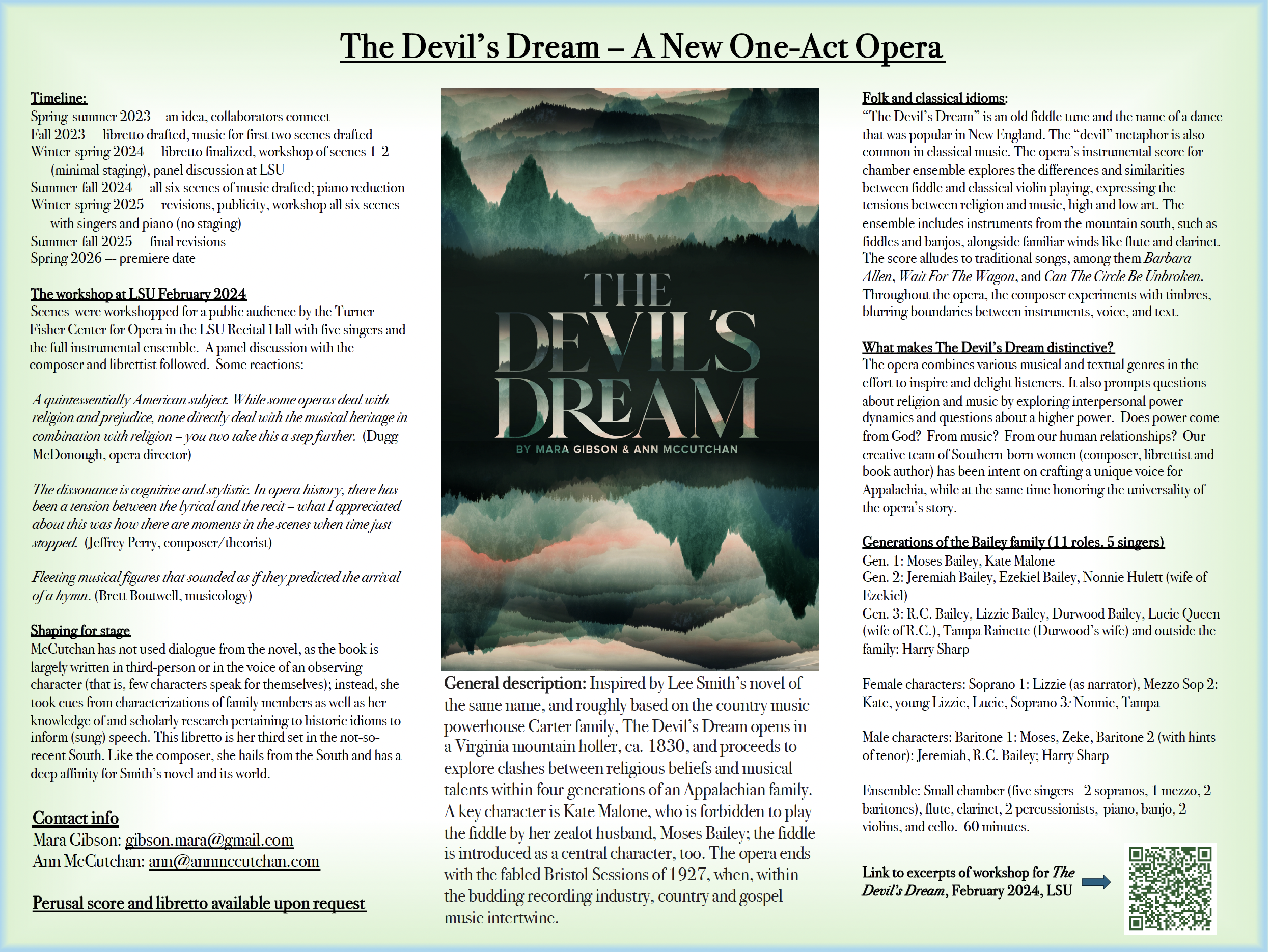
Plot Summary: The Devil’s Dream is roughly based on the country music powerhouse Carter family and chiefly set in a Virginia mountain holler, starting in 1830, when fiddler Kate Malone’s religious zealot husband Moses Bailey forbids her to play her fiddle. His anger destroys their family; a child dies and Kate goes mad (Scene 1). In Scene 2, a surviving son, Zeke, receives a sign from God, is baptized, and marries Nonnie Hulett, who is pregnant by another man. In Scene 3, Nonnie is baptized and settles into domestic life, singing in the house, but becomes restless; Zeke has become a fundamentalist like his father. Nonnie sings at a medicine show and runs off with Harry Sharp, the medicine salesman, for life on the road. In Scene 4, Harry betrays Nonnie; she dies in a hotel fire. In Scene 5, Nonnie’s first son, R.C. Bailey, a wood builder and a brooder — but not religious — discovers he has a gift for the banjo. He meets Lucie Queen, a guitarist; they marry and one day in town, short of cash, they play for tips. A public act is born. In Scene 6, they are joined by other family members and become ambitious performers. The Grassy Branch Girls (three women and R.C.) travel to Bristol for recording sessions, which are a wild success. They attract a popular audience, intertwining gospel and country music. The scenes are lightly narrated by Lizzie, one of Nonnie’s daughters, and the only family member who left the holler for a wider world. She looks back to make sense of her kin.
Instrumentation and details: 5 singers (2 soprano, 1 mezzo), 2 baritones, flute, clarinet, 2 percussionists, piano, banjo, 2 violins (fiddles) and cello. Our opera is structured in six scenes and will run approximately 60 minutes.
Summary – more info and inspiration: Ann McCutchan and I are completing a new opera to come in 2026, inspired by the novel The Devil’s Dream, by Lee Smith, who has granted us permission to adapt the book for musical treatment. Smith’s novel chronicles several generations, beginning in 1830 in a Virginia mountain holler. Our opera is built on relationships and events in the first third of the book, reaching into the fourth generation. A key character in the first scene is Kate Malone, who was forbidden to play the fiddle due to the religious zealotry of her husband, Moses Bailey. Clashes within the marriage represent clashes between religion and music at the time, and foreshadow similar, sometimes violent struggles (in different situations) in the next three generations until a kind of reconciliation occurs in the context of the budding recording industry, when the most musically talented members of the fourth generation secure a popular audience and country/gospel intertwine.
“The Devil’s Dream” is the title of an old fiddle tune and the name of an affiliate dance that was popular in New England in the 1830s. The “devil” metaphor also holds deep meaning in classical music. The opera’s music is composed for a small chamber ensemble, and through instrumentation, explores the differences and similarities between fiddle playing and classical playing to express the larger tensions between religion and music, and between high and low art. The orchestra will include instruments from the Virginia mountain south, such as fiddles and banjos, alongside classical winds like flute and clarinet. The score will include derivations of traditional songs. As well, the composer seeks to continue her recent timbral experiments by blurring boundaries between instruments, voice, and text.
Classical and folk music have long served different audiences, but as “new music” evolves in the 21st century, those boundaries can be stripped, breaking down the question of class (that is, who consumes each genre). Staging and musicalizing The Devil’s Dream will not only be a unique merger of differing musical genres with the hope to make both more accessible, but also to feature three Southern-born women crafting a unique voice for the Appalachian south. Both Gibson and Smith are originally from Virginia.
Excerpts from workshop: